
The way industry buys has changed. Physical trade shows, printed component directories, or traditional cold outreach are no longer the ways corporate procurement finds suppliers. Instead, procurement agents, engineers and supply chain executives today do their own deep, independent research online before ever talking to a sales rep.
If you are an industry company looking to win high-value contracts, you need to build an authoritative, technically sound web footprint. This comprehensive guide explains how today’s plants can grow from legacy outreach into high-yield, data-backed digital marketing for manufacturers. We examine the particular tactics that are required to build trust, shorten long sales cycles, and win intent-driven business-to-business (B2B) accounts.
From Physical Trade Shows to Digital Self-Service
For years industrial marketing was rooted in annual conventions and face-to-face networking. Physical exhibitions still have some value from time to time, but they are no longer the main pipeline growth driver. Modern B2B marketers understand that procurement teams are looking for a self-service model and research technical specifications and production capacities on the web only.
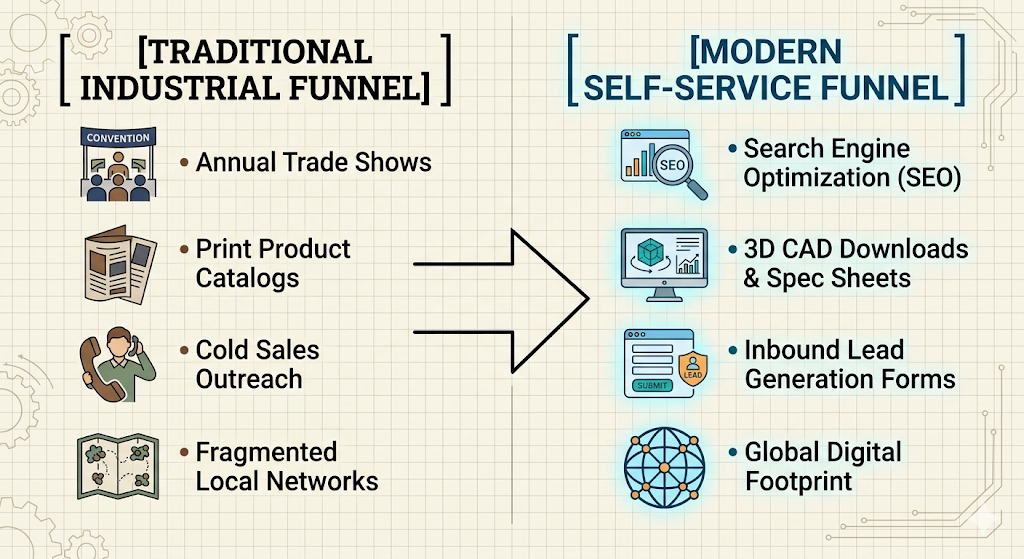
When a prospective customer recognises a supply chain weakness or needs a specialised component vendor, they start with an online search. Without an optimised, visible presence at your production plant, your brand is eliminated from the bidding process before it even begins.
1. Creating High Performance Industrial Websites
An industrial platform is much more than a company brochure. This is your main sales portal, technical resource library and engineering hub. Your site architecture needs to be built around user intent so that it attracts commercial interest and increases low conversion rates.
CAD integration and technical documentation
Engineers and procurement managers want precise technical specs. They are not buying the usual marketing spiel. Your platform shall need to provide:
- Downloadable 2D/3D CAD models for standard industrial software.
- Full material data sheets, tolerance charts and compliance certificates (e.g. ISO or AS9100).
- Detailed production capacity, list of machinery and minimum order quantities (MOQs).
Improve Website Traffic and User Experience
Removing user friction is critical to transforming casual website traffic into high-value Requests for Quotes (RFQs). Major optimisations include rapid page load speeds, mobile responsive layout designs for floor managers and an intuitive search tool to allow users to find specific part numbers or capabilities instantaneously.
2. B2B Procurement Strategic Search Engine Optimisation (SEO)
Understanding commercial search intent is important to rank at the top of search engine results pages (SERPs). In most cases, you can’t make money on general keywords. The real money is in highly specific, long-tail technical queries.
Managing Long Sales Cycles with Informational Search Engine Optimisation SEO
Industrial buying is done in multi-month windows, with multiple stakeholders and large financial commitments. To combat these long sales cycles, your SEO strategy has to provide deep value throughout the decision-making process:
- Top-of-Funnel (ToFU): Informational posts addressing general engineering problems or discussing material choices.
- Middle-of-Funnel (MoFU) In-depth comparison guides, processing tolerance breakdowns, technical whitepapers.
- Bottom-of-Funnel (BoFU): These are intent-driven phrases like “aerospace component casting plant” or “custom injection moulding supplier near me.”
By optimising your content for each unique stage, you create lasting credibility with procurement teams as they go through their long evaluation.
3. High Impact Content Marketing and Case Studies
In B2B industrial markets, showing what you can do is far better than making claims. Content marketing for specialised production lines is all about transparency, mechanical accuracy and historical proof.
The Strength of Detailed Case Analyses
Data-backed case studies are one of your best tools for closing enterprise deals. A well-structured industrial case study should clearly show:
- The Challenge: What the client was really going through (high component failure rates, supply bottlenecks, out-of-spec parts, etc.)
- The Solution: The detailed approach your engineering team took in the technical problem, the machinery used, and the material adaptations chosen.
- The Result: Quantified results including percentage reductions in lead times, improved durability of parts, or cost savings realised.
Manufacturing Digital Marketing Strategy: A Real-World Guide
A good digital marketing strategy for manufacturing takes complex shop floor processes and translates them into easy-to-understand digital assets. Educational blogs on new machining capabilities, downloadable compliance guides and video walkthroughs of your automated production lines all help position your plant as an authoritative industry leader.
4. Google Ads Targeted Advertising
While organic visibility takes time to build, targeted pay-per-click (PPC) campaigns are a direct way to attract active buyers. Google Ads allows an industrial brand to appear when a procurement agent is looking for a supplier on the spot.
B2B Marketers’ Guide to Managing Negative Keywords
A common problem B2B marketers encounter in managing industrial ad spend is how to cut consumer traffic. For instance, a commercial plastic injection moulding business should not be paying for clicks from DIY hobbyists.
You can make sure that your budget is spent on true commercial intent by setting up strict negative keyword lists to filter out words such as “cheap,” “hobby,” “home,” “repair manual,” or “retail.”
Lead Generation Optimised Landing Pages
You’ve lost an ad click if you drive people to a generic homepage. Paid traffic should be directed to targeted landing pages that are highly specific and relevant to the search query. Include quality certifications, state production capacities and a simplified RFQ form within these pages to maximise your lead generation efforts.
5. Google Ads for Targeted Advertising
Pay-per-click (PPC) campaigns are a way to reach active buyers right away, as it takes time to grow your organic visibility. Google Ads allows an industrial brand to be there at the exact moment a procurement agent is looking for a supplier, right away.
B2B Marketers’ Guide To Negative Keyword Management
One of the biggest challenges for B2B marketers running industrial ad spend is filtering out consumer traffic. A company that does commercial plastic injection moulding, for example, doesn’t want to pay for clicks from DIY hobbyists.
Use strict negative keyword lists to filter out words like “cheap”, “hobby”, “home”, “repair manual” or “retail” to make sure your budget is spent on real commercial searches.
Landing Pages Optimised for Lead Generation
A click that brings users to a generic homepage is a wasted click. Paid traffic should go to very specific, very focused landing pages that match the search query exactly. To boost your lead generation, these pages need to showcase quality certifications, mention production capacities, and include an easy RFQ form.
6. Social Media Platforms for Industrial Usage & Video Verification
“Social networks are no longer the playground of consumer brands. Selective social spaces, used strategically, are powerful channels for brand building and connecting with corporate decision-makers.
B2B Professional Engagement
LinkedIn is still the #1 channel for reaching supply chain executives and corporate buyers. Sharing news of plant expansions, new equipment installations, and industry awards all help keep your facility top-of-mind for major contracts.
Video Plant Capability Verification
For manufacturers, YouTube is a powerful visual marketing catalogue. By showing high-definition video content of your automated assembly lines, precision CNC hubs or rigorous quality control processes, you are giving direct visual proof of your capability. That openness builds trust with buyers from other countries or other states who can’t see your facility for themselves.
7. Applying Automation and Real-Time Analytics
Once your online channels start bringing in regular leads, your team needs to have effective systems in place to track, score and nurture those relationships over time.
Automate Operations for Efficient Processes
Modern marketing automation solutions bridge that gap from first digital contact to the final purchase order. What these systems can do:
- Automatically route incoming RFQs to the appropriate regional sales engineer based on the request criteria.
- Use automatic email nurturing sequences that send technical whitepapers to prospects who are in the process of evaluating options in long sales cycles.
- Track prospect activity and alert your sales team when a key account downloads a technical spec sheet.
Real Time Data Interpretation
To keep a successful online presence, continuous measurement is required. Real-time data analysis means your marketing team knows exactly which channels are adding value.
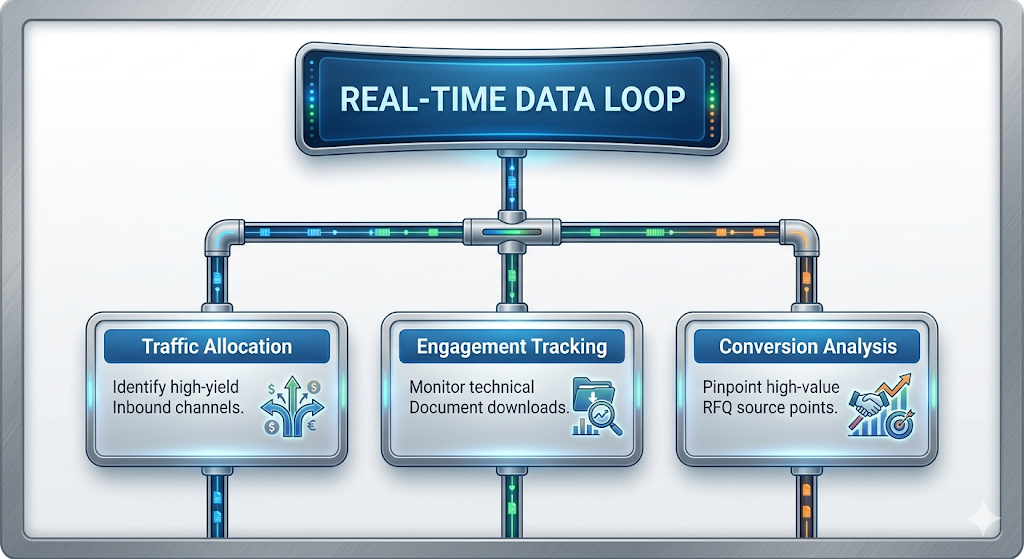
By monitoring these real-time operational metrics, administrative teams can allocate marketing budgets effectively, ensuring resources remain focused on the channels that drive the highest-value contracts.
A Strategic Way Forward
To stay ahead of the competition in today’s industrial world, you need to embrace digital modernisation. You can make your facility an inbound client-generation machine by building a high-performing website, optimising high-intent search queries, and leveraging a clear visual proof. Partnering with niche B2B experts keeps your system compliant, visible and highly profitable in the long run.
FAQs
Engineers, procurement agents and financial directors go through multi-stage evaluations in industrial buying processes. Offering technical documents for download, 3D CAD files and structured case studies on your website answers technical questions up front. This digital self-service model accelerates stakeholder alignment and the procurement timeline overall.
A good framework is based on a fast, mobile-responsive website with clear technical specifications and ISO quality certifications. It’s built around localised search engine optimisation seo to find commercial buyers, strategic Google Ads with tight negative keywords to filter consumers, and active B2B social media engagement to demonstrate facility capacity.
LinkedIn is the best platform to reach supply chain managers, procurement executives and corporate decision makers. For technical and engineering audiences, YouTube is a great return on your investment, acting as a visual proof-of-capability repository where you can show live machinery demos, plant automation tools and rigorous quality testing setups.
By integrating advanced web analytics with a centralised CRM platform, businesses can track a user’s journey from the very first ad click or organic search query all the way to the final closed RFQ. It provides crystal clarity on marketing performance, tracking key metrics such as landing page form completions, technical document downloads, and cost-per-lead updates.
Consumer marketing often works on a short decision window, which is aimed at impulsive purchases and leads to a higher volume of immediate transactions. Manufacturers’ marketing, on the other hand, is dealing with high-value, low-volume enterprise contracts, with complex compliance and supply chain requirements. Therefore, success is based on the total dollar amount of qualified RFQs created, not transaction volume
Highly technical buyers don’t respond to generic promotional messaging. Focused content marketing—such as detailed engineering whitepapers, material selection charts, and performance case studies—shows true domain expertise. Deep, accurate answers to complex manufacturing challenges establish long term trust with prospective clients before they even reach out to your sales team.