Search marketing today requires more than just a budget allocation. Enterprises need to collaborate with an experienced data driven team to deliver sustainable returns. Brands need advanced strategies that directly address user intent so every marketing dollar achieves measurable business results.
The Changing Landscape of Paid Search
Today’s search environments have evolved from simple keyword matching to sophisticated contextual understanding. Machine learning models now look at query context, device location, past user behaviour and micro-intent before deciding where an ad should be shown.
No business can succeed in these conditions with manual, outdated adjustments. Success is built on an analytics-first foundation that views paid search as an interconnected framework of audience data, predictive bid management and highly adaptive ad copy.
The New Paradigm of Intent-Driven Match Types
The game changed for phrase and exact match dynamics with search engines, making traditional account structures obsolete. Broad match, combined with a powerful smart bidding infrastructure, can capture valuable long-tail traffic that traditional keyword lists simply can’t.
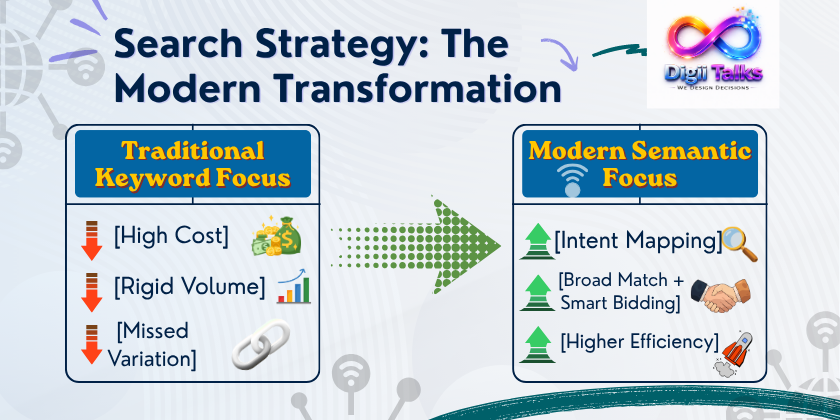
But to manage broad match well, you need tight guardrails. It needs a steady flow of negative terms and the right filtering of the audience otherwise the budget will leak.
Algorithm alignment and predictive bidding
Smart Bidding strategies like Target ROAS (Return on Ad Spend) and Target CPA (Cost Per Acquisition) are very data-dependent. If an account feeds shallow conversion signals to the algorithm, the automated bidding system will optimise for low-value actions.
Enterprise brands need to implement server-side tracking and sophisticated customer data platforms that push deep bottom-of-funnel conversion milestones right back into the advertising interface.
The Multi-Channel Asset Allocation Maze
Paid search doesn’t operate in a vacuum. A modern enterprise digital strategy covers search networks, performance Max assets, video environments and localised discovery feeds. To manage these channels, a one-strategy approach is required that prevents internal cannibalisation of keywords and provides a consistent message throughout the entire customer journey.
Funnel-Wide Strategic Asset Deployment
| Funnel Stage | Primary Network | Core Metric | Creative Asset Focus |
| Top of Funnel (Awareness) | YouTube & Demand Gen | View-Through Rate / Lift | High-impact video, lifestyle imagery |
| Middle of Funnel (Consideration) | Performance Max / Discovery | Engagement Rate | Product benefit carousels, comparison text |
| Bottom of Funnel (Conversion) | Search Network | Conversion Rate / ROAS | Solution-specific text, value propositions |
The benefit of organising assets by this framework is that marketing teams can speak to prospects with relevant messaging at all touchpoints. This organised approach minimises conversion friction and increases overall budget efficiency.
Why Strategic Management Requires a Google PPC Agency by DigiiTalks
To achieve the best results, you need an outside partner who can convert complex platform metrics into simple business growth. DigiiTalks is a premium google ppc agency that provides the technical sophistication, structural auditing and optimisation protocols required to turn raw traffic into loyal clients.
Framework Optimisation Protocols
- Deconstructed Account Blueprints: To keep ad quality scores at a maximum and to ensure the best relevance of ads, campaigns are structured around clear thematic parameters.
- Integration of First-Party Data: Link offline CRM data to target lookalikes of your high value customers.
- Landing page testing (iterative): Building robust multivariate testing solutions to enhance post-click experiences and increase conversion rates.
The team moves beyond shallow optimisation metrics such as click-through rates and instead focuses directly on increasing net margins and accelerating pipeline velocity.
The Tactical Execution Blueprint of a Google Ads Specialist
To run profitable ad campaigns, you need a dedicated analyst who understands the ins and outs of modern digital advertising. A certified google ads expert combines deep data analysis with creative strategy. Every day this specialist adjusts targeting variables in order to protect ad spend from low-quality web traffic.
Overall Quality Score Management
Quality Score, which is based on expected click-through rate, ad relevance and landing page experience, is a big factor in ad rank. A systematic optimisation process ensures ad copy stays current to make the perfect match with user search intents.
By optimising these three foundational elements, we can reduce average cost-per-click and help client accounts win premium ad placements without increasing media spend.
Advanced Negative Matching Frameworks
Just as important as targeting active search queries is the management of negative keywords to protect valuable advertising budgets. Analysts also have detailed master negative lists that filter out job seekers, educational searches, and low-intent research terms, so only ready-to-buy audiences are reached.
How to Create High-Performing Google Ads Campaigns
Building high-yield google ads campaigns is a combination of technical accuracy and psychological alignment. A truly optimised account is one that makes use of advanced responsive search ads that automatically adjust to the context of a user.
Guide to Optimising Responsive Search Ads
- Create Unique Headlines: Write fifteen unique headlines highlighting specific user benefits, technical specs, and clear calls to action.
- Add Dynamic Keywords: Use dynamic inserts in a natural way to match exact user search terms, while maintaining editorial quality.
- Concentrate on the Best Performing Assets: Review asset performance ratings on a weekly basis and replace poorly performing copy variations with new high angle text options.
Maximise Performance With Ad Extensions
The ad copy you need today takes up a lot of real estate on search engine result pages. Adding strong sitelinks, structured snippets, callouts and lead forms increases visibility and provides prospects with direct points of conversion in the search results.
Post Click Conversion Rate Optimisation: Reducing Friction
Getting qualified traffic to a website is only half the battle, the traffic has to convert as well. Conversion optimization is about the whole experience, from the ad copy to the landing page. Bounce rates soar and ad budgets are wasted when a landing page fails to deliver on the ad’s promise.
Maximising the Contextual Relevance
The landing page should reflect the tone, offer, and message of the ad that brought the visitor. If a user clicks on an ad for a specific enterprise software solution, the landing page should promote that specific solution, not a generic corporate home page.
Landing Page Technical Performance Metrics
- Core Web Vitals: To keep users from bouncing off your site, make sure your Largest Contentful Paint is less than two seconds.
- Frictionless Form Design: Limit the number of fields to the most necessary information and employ progressive profiling for repeat visitors.
- Clear Value Propositions: Put the main calls to action above the fold, making them easy to see in both desktop and mobile layouts.
Data-Driven Attribution & Advanced Marketing Analytics
Relying on outdated last-click attribution models can result in poor budget allocation. Modern consumer journeys include multiple touchpoints across multiple devices and channels before a conversion is completed.
Shifting to data-driven attribution
Data-driven attribution models use advanced machine learning to understand the true impact of each touchpoint on the conversion path.
This granular attribution allows marketing teams to understand which top-of-funnel awareness campaigns are actually generating bottom-funnel conversions and avoid accidentally pausing important top-of-funnel channels.
Sophisticated Tagging and Privacy-Oriented Tracking
As third-party cookies are being phased out, it’s important to put in place privacy-safe tracking frameworks. Sophisticated site-wide tagging with server-side tracking guarantees reliable data collection while respecting user privacy choices. The infrastructure provides clean and reliable data feeds that allow smart bidding algorithms to optimise campaign performance effectively.
Continuous Optimisation: The Key to Continuous Growth
The digital marketplace is constantly changing with competitor strategies, search behaviours and platform features changing rapidly. Staying competitive takes a constant cycle of auditing, testing and sharpening.
Account Health Checklist Weekly
- Search term review: Review search term reports to find new negative keywords and find new keyword opportunities.
- Bid Adjustment Audits: Benchmark manual overrides across devices, geographic regions and times of day for performance optimisation.
- Optimising Budget Expenditure: Get the most out of your daily budget by moving capital away from the underperformers and into the high performers.
Working with a nimble team means your paid search efforts are flexible to change with the realities of the market. Your google ppc efforts become scalable business growth engines, not just another line item in your operating budget.
FAQs
When you partner with a dedicated agency, you have access to deep technical expertise, proprietary optimisation frameworks and advanced cross-industry data for your strategy. Internal teams often wear many marketing hats, making it difficult to keep up with rapid platform changes, script automations and complex tracking configurations. Dedicated analysts from an external specialist constantly optimise campaign structures, improve quality scores and reduce overall acquisition costs.
An expert looks at the three key elements of Quality Score (expected click-through rate, ad relevance and landing page experience) and works to align them. They deliver a seamless post-click experience using tightly themed ad groups, writing highly relevant responsive search ads and optimising landing page performance. The optimisation helps reduce average cost-per-click rates and secures premium ad placements, without having to spend more on media.
Last-click attribution is broken because it assigns all the credit for a conversion to the last interaction, ignoring the important mid-funnel touchpoints that help a prospect make a decision. Data-driven attribution measures the true impact of each touchpoint across the customer journey using sophisticated machine learning. This holistic view allows marketing managers to accurately allocate budgets, protecting early-stage awareness campaigns that result in valuable bottom-of-the-funnel conversions.
The best campaigns beat rising costs by building strong topical authority and using advanced audience segmenting. Smart Bidding guardrails and broad match keywords work hand-in-hand to help your campaigns capture high-value, long-tail searches with less competition. Additionally, combining first-party customer data allows companies to concentrate their budgets on the right customer profile and avoid spending money on audiences with low conversion rates.
The quality of your landing page will have a direct impact on your Quality Score and on your conversions. Slow load times frustrate new visitors and cause them to leave the site without taking any action, which signals to search algorithms that the user experience is poor. You can reduce your cost-per-click and ensure that your paid traffic is landing on a fast, high-converting website by improving your server response times, optimising your mobile layouts, and keeping your Largest Contentful Paint score low.
Negative keyword lists need to be actively managed over time, rather than being set up and forgotten. When a campaign launches for the first time, check search term reports daily to filter out irrelevant, non-converting traffic. For accounts that have been around for a while, a weekly review is usually enough to catch changing search trends, refresh master negative lists and keep ad spend laser focused on high intent commercial queries.