To create a consistent income system, you need to shift from uncertain advertising spend to measurable customer acquisition systems. In modern commercial ecosystems, there is accountability for every ad dollar spent. Traditional branding campaigns are measured in terms of reach and subjective impressions, while structured performance media is all about bottom-line results, lower customer acquisition costs and predictable return on ad spend.
Businesses can leverage qualified performance marketing companies to gain the strategic framework and technical architecture needed to capture high-intent buyers, scale paid channels, and build sustainable market authority. This guide covers operational channels, measurement models, attribution frameworks and campaign execution strategies needed to optimise paid acquisition investment.
The Transition to a Responsible Paid Media Model
Financial predictability is important for commercial growth. In a typical standard marketing set-up, companies often spend large amounts of money on broad channels with no concrete tracking mechanisms to know which ads are leading to actual sales. This opacity leads to capital wastage, sub-optimal targeting and stagnant market growth.
Modern performance architecture reverses this traditional dynamic. We track every impression, click, form submission and completed transaction back to the traffic source it came from. Marketers can measure real-time metrics allowing them to quickly re-allocate budget to high-performing ad sets while pausing underperforming angles. By teaming up with a Performance Marketing Agency that’s committed to your brand, you can make sure your creative messaging and audience targeting are in sync, turning your marketing spend from an uncontrollable expense into an investment.
When media spend has a direct link to financial returns, leadership teams can confidently plan inventory, staffing and operational expansion. Predictable growth needs the synergy of data analytics, engaging ad creative, quick landing pages, and dynamic multi-channel optimisation. With a solid tracking system in place, business owners can fully control how much they’re spending to acquire customers across all of the marketing channels they’re currently using.
Core operational channels: paid search & paid social integration
A steady volume of acquisitions is achieved through the balancing of active search intent and passive social discovery. Dependence on a single advertising platform creates channel risk, while a diversified media mix preserves campaign stability and increases overall addressable market size.
Harnessing Active Demand with Search Engine Marketing (SEM)
When prospects are looking for specific products or service providers, they already have immediate commercial intent. Capturing this traffic at the exact moment of search generates high conversion rates.
- Google Ads: When users type in high-intent commercial queries, well-structured Google Ads campaigns can place your business directly above the organic search results. Businesses capture prospects actively looking for solutions by implementing targeted Search Engine Marketing (SEM) strategies.
- Paid Search Architecture: To run an effective paid search campaign, you must do thorough keyword research, apply negative keyword filters, structure your match types correctly and continually work to improve your Quality Score. Matching particular ad copy to user search intent improves click through rates and decreases overall Cost-Per-Click (CPC).
- PPC Management: With systematic PPC management, you can change your bids on the fly depending on the user’s device, location, time of day and audience demographics. This ensures that your money is being spent in the best possible place.
Paid Social Media to Build Passive Demand
The business of search engines is to capture demand that already exists. Social media networks create demand by exposing products to highly targeted audiences of consumers.
- Meta Ads Framework:
Meta Ads enables businesses to send visual ad creative directly to targeted audiences on Facebook Ads and Instagram Ads platforms. Advanced algorithm targeting users by interests, online behaviours, purchase history and lookalike modelling.
- Facebook & Instagram Ads Implementation:
Build instant brand love with eye-catching carousel formats, short-form video placements and interactive collection ads on Facebook Ads and Instagram Ads. Testing hooks, visual angles and direct call-to-action variants identifies winning creative combinations that reduce customer acquisition costs.
Ad Creative Development & Messaging Frameworks
High-performing ad media relies on psychological messaging as much as it does on technical campaign targeting. Even the best audience algorithm can’t convert prospects if the ad creative doesn’t grab attention in the first 3 seconds.
Four structural elements are essential for effective creative messaging:
- The Pattern Disrupt Hook: Capturing initial user attention through striking visual elements or relatable problem statements that stop social media scrolling.
- Clear Value Proposition: Articulating how your product or service solves a specific pain point faster, better, or more cost-effectively than alternatives.
- Authentic Social Proof: Integrating real customer reviews, video testimonials, press mentions, or industry certifications to build immediate credibility.
- Direct Call to Action: Guiding the user precisely toward the next step, whether claiming a trial, scheduling a call, or buying a product.
Paid Ads versus Traditional Branding Techniques
It is important for business leaders to understand the structural differences between a brand awareness campaign and a performance-focused paid acquisition campaign so they can set realistic expectations and measure meaningful progress.
| Marketing Metric | Traditional Brand Awareness | Performance Paid Media |
| Primary Goal | Broad visibility and brand recall. | Direct Lead Generation and measured ROAS (Return on Ad Spend). |
| Key Metrics Tracked | Impressions and broad reach. | Cost Per Lead (CPL), Cost Per Acquisition (CPA), and ROI. |
| Budget Allocation | Fixed quarterly budgets allocated to high-reach channels. | Fluid budgets scaled dynamically based on positive ROAS (Return on Ad Spend). |
| Optimization Velocity | Monthly or quarterly reviews. | Continuous Campaign Management optimizations based on real-time data. |
| Channel Focus | Billboards and general broadcast media. | Google Ads, Meta Ads, Paid Search, and retargeting networks. |
Attribution, Tracking and CRO: The Technical Infrastructure
Launching ad creatives on Google or Meta is just half of the acquisition equation. There’s a lot of tech behind the scenes that will help you turn paid traffic into paying customers.
Conversion Rate Optimization (CRO) & Landing Page Design.
Traffic that doesn’t convert is wasted ad spend. Sending paying visitors to generic home pages reduces intent, and return. Instead, custom landing pages for specific ad groups take prospects through one clear action.
Implementing systematic Conversion Rate Optimization (CRO) involves:
- Headline Alignment: Ensuring the landing page headline directly matches the visual promise and text hook of the ad creative.
- Frictionless Form Architecture: Reducing required form fields to lower user effort while maintaining essential lead qualification criteria.
- Visual Trust Elements: Displaying verified customer testimonials, security badges, industry accreditations, and clear contact details adjacent to action buttons.
- Page Speed Optimization: Technical optimization ensuring landing pages load under two seconds on mobile devices to prevent visitor bounce.
Multi-Touch Attribution and Tracking Configuration
The modern customer journey is seldom a straight line. A user sees an Instagram ad for a brand, two days later searches for the service on Google Search, and then fills out a form after receiving a targeted retargeting email.
Establishing clear tracking protocols requires:
- API Server-Side Tracking: Implementing Conversions API (CAPI) alongside traditional browser pixels to prevent data loss from browser privacy updates.
- Custom UTM Parameter Frameworks: Attributing every ad click to its exact creative variation, target audience segment, and campaign objective.
- Data Analysis Integration: Synthesizing advertising dashboard metrics with internal CRM sales data to calculate actual customer lifetime value and true contribution margin.
Creating a Comprehensive Marketing Plan for Sustainable Growth
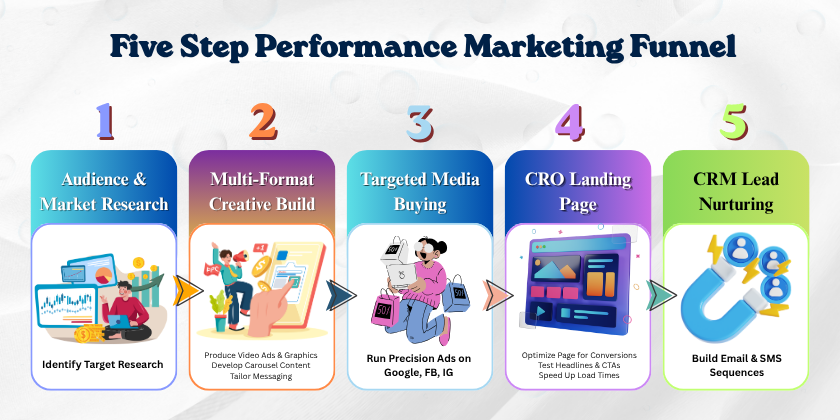
Scalable performance acquisition is not about ad creation, it is about structured planning. A comprehensive Marketing Strategy combines audience research, ad creative development, platform management and post-click follow-up into a single pipeline.
Phase 1: Audience segmentation and creative development
Marketers look at customer pain points, buying objections and demographics before launching campaigns. Teams are creating a wide range of ad creative like video customer reviews, problem-solution demos, comparison charts, and offer-based images.
Phase 2: Campaign Structure and Testing Framework
Clear campaign structure prevents internal bidding competition and accelerates algorithm learning. Marketers can create isolated testing budgets to systematically test headline hooks, visual formats and audience segments without jeopardizing their baseline account stability.
Phase 3: Ongoing Campaign Management and Optimization
Continuous Campaign Management includes tracking performance patterns, reallocating budgets to successful ad sets, refreshing creative assets to avoid ad fatigue, and optimizing keyword bidding strategies. This disciplined management cycle allows customer acquisition costs to remain constant as spend grows.
Why Partnering With Digii Talks Leads to Measurable Sales Growth
Managing complex ad algorithms, tracking updates and creative requirements requires technical skill and constant focus. Digii Talks is a Digital Marketing Agency that specializes in turning Ad Spend into predictable Revenue Growth.
Unlike vanity metrics such as impressions or simple video views, Digii Talks is focused entirely on the business outcomes that matter: Sales Growth, qualified lead volume, reduced acquisition costs and maximizing ROI.
Our operating framework is:
- Full-Funnel Campaign Architecture: Connecting high-intent Google Ads search campaigns with engaging Meta Ads social funnels for maximum market coverage.
- Custom Landing Page Engineering: Designing fast, conversion-focused landing pages that maximize ad spend efficiency through rigorous Conversion Rate Optimization (CRO).
- Rigorous Data Transparency: Providing clear reporting dashboards that tie ad spend directly to verified customer actions and revenue outcomes.
By testing again and again and again you ensure your advertising campaigns evolve with the times, reacting to shifts in the market and in consumer behavior. Maintaining agile creative pipelines and daily performance metric analysis keeps your marketing strategy resilient, profitable and ready to seize emerging growth opportunities in modern competitive industries. Digii Talks turns paid channels into a scalable, predictable customer acquisition system and powers the long-term growth of your business.
FAQs
Traditional agencies are often focused on broad brand awareness, creative design, and reach metrics such as impressions. Performance agencies on the other hand measure their success by business results such as Cost Per Lead (CPL), Return on Ad Spend (ROAS) and net revenue generated. Each dollar spent can be traced back to a specific conversion so marketing costs can be held directly accountable for sales performance.
Click-through rates (CTR) and Cost Per Click (CPC) give useful operational feedback but the most important metrics remain Customer Acquisition Cost (CAC), Return on Ad Spend (ROAS), Conversion Rate and total Return on Investment (ROI). Tracking these bottom line numbers helps ensure that advertising is directly supporting business profitability.
Immediately after approval, traffic opens from paid ad channels like Google Ads and Meta Ads. The first 7-14 days are used to collect the first campaign data. This data provides the algorithm with the signals it needs to optimize. For fully optimized accounts with refined audience targeting and winning ad creatives, performance generally levels out in 30 to 60 days.
No matter how good the ad is, sending paid traffic to a poorly optimized landing page is a waste of budget. Conversion Rate Optimization improves landing page messaging, page load speed and user experience, so that a higher percentage of visitors convert into leads or sales without increasing overall advertising spend.
The problem with testing ad campaigns is you need a big enough budget to get statistically significant conversion data for the algorithms to learn. The majority of businesses begin with a fixed monthly testing budget across platforms such as Google and Meta, enabling teams to identify winning creatives and audiences before scaling spend based on a positive ROAS.
Digii Talks additionally leverages server-side Conversions API (CAPI) tracking along with custom UTM parameters and CRM integrations. This advanced tracking setup skips browser privacy restrictions, allowing for accurate lead attribution, reliable data collection, and efficient algorithm optimization across all campaign channels.